Posts

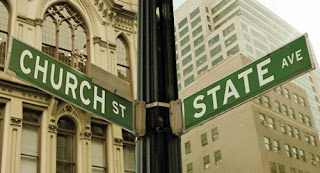
Should the state privilege one religion?
Image
 What is the role of the state? Let's set up the elements of the decor: crucifixes are hung in the classrooms and the Council of State has an official place in the Corpus Christi procession. Businesses are subject to church tax, and all taxpayers contribute to the financing, through ordinary taxes, of the Roman Catholic Faculty of Theology. Does the State consider agnostics and those who are indifferent to religion to be lost sheep that it should, if possible, bring back into the right flock? When Christians proclaim their hope that the coming century will become religious again, do they hope to revive indoctrination? Just as there is a reason of state, can we invoke a reason of Church that prevails over respect for people? Do we live in a crypto-confessional state, i.e. non-confessional in its statements and appearance, but confessional in its interior and functioning? Do supporters of a residual clericalism give their support to Muslims who, in their respective countries, demand ...

Clericalism and secularism in the canton of Fribourg (Switzerland)

Image
About the collusion between the Catholic Church and the State of Fribourg Diminished, but still very present: clericalism in the style of Fribourg In 1978, when I was hired as a teacher in a high school in the canton of Fribourg, it was imperative to have an approved denomination, even to teach mathematics. As I had deliberately omitted the religion section of my curriculum vitae, the headmaster demanded that I add it. In 1980, suspected of having links with a sect, a fellow French teacher was dismissed. The state took care of the teachers' private lives to ensure their ideological conformity. A characteristic feature of intolerance is the demonisation of those who do not share the pseudo-truths of the community. In this context, I had to hide my atheism. This is how I was deprived of religious freedom for many years. As the situation evolved only slowly, I never knew when I regained my freedom of belief. Clericalism has diminished, but it remains very present. Even today, essent...

Clericalism, never again! - Testimony

Image
In the canton of Valais (Switzerland), Catholicism was the state religion until 1973, which meant that I spent my childhood and youth in a deeply clerical society. The present text aims to explain, in a particular case, the intimate workings of clericalism, seen from the inside by the teenager I was. The primary school (1955 – 1960, Fully) Boys and girls were separated in two different buildings. Although the school was public and compulsory, the typical day began with the recitation of the catechism. The book, consisting of questions and answers, had to be recited by heart. At the end of the book, we would start from the beginning, and so on for the duration of the primary school. On Sundays, the pupils had an appointment in front of the school to go to mass, in columns of two, under the guidance of the teacher. Attendance was controlled. In addition to the catechism, there were also courses of religious instruction. In preparation for the first confession, I memorized a list of sins ...

Healing - Outline of a philosophical tale

Image
Characters The following characters appear in this tale: The musician Our musician is an artist in every sense of the word, even the less glamorous ones. He has composed melodies that have accompanied the most famous films, composed songs for famous singers. He leads a chaotic life, remarries every year, spends some episodes of his life in drugs, others in detoxification. He is invited to star-studded television shows. He is interviewed by the press, both on his musical work and on his latest conquest or relapse. He does not wallow in his relative unhappiness and seeks a way out that constantly eludes him. The Philosopher Whoever appears here is immensely cultivated and very productive. Being somewhat depressed and occasionally tempted to commit suicide, he has written moving pages about the nonsense of existence, which has brought his fame beyond the oceans. When he writes that man is irretrievably mired in the misfortune of his fate, he feels a great inner joy of being so brilliantly...

The search for happiness - Philosophical tale

Image
Year 1 [ The disciple ] My parents made me a Catholic and I am trying on this path that will lead me to salvation. [ The wise man ] Are you happy here now? [ The disciple ] No, the hope of future happiness does not make me happy here now. [ The wise man ] Do you feel fulfilled in your search? [ The disciple ] In Christianity, man is born guilty, and throughout his life he remains guilty of not doing enough to save his soul; thus, happiness is not of this world. Well, I don't want to give up happiness. [ The wise man ] There is not just one path to happiness, the same for everyone, because everyone must find his or her own way. If one day I stretched out my finger to show you a path, it is neither the finger nor the path that must be observed, but the procedure for determining your path. [ The disciple ] I understand, I have to look for a better way. Year 2 [ The disciple ] He who is content to follow the tendencies of his environment renounces being himself. His personal consciousn...

From the stick as a gift to the meaning of life - Philosophical tale

Image
The Straight Sticks clan This story took place in ancient times when man was a hunter-gatherer. The Straight Sticks clan, favoured by a favourable forest environment, had acquired great know-how in the art of making perfectly straight sticks, both solid and slightly flexible, of all sizes. Together with his neighbours, he bartered these sticks for hunting, fishing and gathering products. The Sacred Sticks clan Following a barter, the Sacred Sticks clan received a stock of straight sticks. The sorcerer gathered the clan and, pointing to a straight stick that he described as sacred, made a speech: As our gods have communicated to me and as I have taught you, straight sticks are sacred sticks, that is to say divine objects, on which we will be able to lean during our journey in the afterlife. I am going to distribute a sacred stick to each one. You will have to keep it preciously because when you die, we will bury it beside you. It will serve you eternally. The Pragmatic clan Following a ...

The ultimate religion: Adepts of Terminus

Image
  «Adepts of Terminus», also known as AT (in French, AT and "Atheist" are pronounced in the same way, LOL), take their name from the fact that they believe that people's lives have an end. Their religious thought achieves the synthetic and rectifying fusion of deism and atheism. As such, AT thought represents the crowning achievement of the philosophical and religious evolution of humanity. Foundations of the AT doctrine When they die, individuals are weighed, not according to their behaviour, but according to their faith. "Terminus" is the true name of the spiritual force that carries out the sorting. Terminus is righteous, venerable, full of goodness, and His spirit is devoid of all vengeance. The cult of Terminus consists in attributing only praiseworthy intentions to Him. Terminus asks men to forgive their enemies, but, unlike false gods who do not follow the commandments they have given, He does not threaten poor sinners with the worst punishments. He, who ...

Freeing oneself from the grip of religion

Image
Question or objection Even if they are convincing from a rational point of view, there is something that atheists do not understand in religion and in the attachment of believers to their faith because they have not experienced a religious adventure. Answer Attachment to religion is quite natural. Indeed, human beings do not primarily care about the truth, because they first ask for reassurance. Against the scarecrow of the Last Judgement, a protection must be built. The desire to believe is often formed in childhood, then invested in faith. It is quite normal that, in a first movement, the survival instinct and the attachment to the missing persons take precedence over a reflection with a concern for objectivity. But, since religion takes us out of reality, it is reasonable to go beyond this spontaneous reaction which turns into fantasy. Giving precedence to desire is a form of pride that a lucid adult should renounce. I prefer to see the worries and tragic aspects of life manifested ...

Succeeding in the abandonment of faith

Image
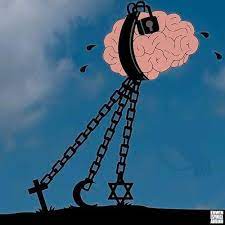
Religion cultivates anxiety better than happiness. How can we free ourselves from the grip of religion? How to give coherence to one's life? Overcoming psychological and social resistance Religions stir up misguided feelings that generate inner tensions, such as sin and guilt. By virtue of original sin, the Judeo-Christian, victim of a curse, is born punished, sinful, potentially guilty, and must redeem himself. In order to face dangers, even imaginary ones such as hell, supernatural protection, such as that of the sacraments, is deemed necessary. Under the weight of such intimidation, all that remains is to pray, confess one's sins and atone. The one who succumbs to the feeling of guilt is trapped: he will have to perform ritualised acts to alleviate anxiety and follow precepts supposed to appease the deities. Man has a sickly propensity to anguish needlessly and to torture himself. It is not convenient to stop believing, because it means admitting that our life has, until now...